.png)
What was the central goal?
Tools: React, agent-based modeling, Kansei Engineering theory, USGS seismic data
The Provocation
Buildings fail people before they fail structurally.
That claim took years to fully articulate. The seed of it goes back to my MArch thesis, which investigated how the aesthetic conditions of emergency infrastructure affect occupant behavior. The thesis drew on Kansei Engineering — a methodology developed by Mitsuo Nagamachi that maps sensory and emotional responses to designed environments — to argue that the "feel" of a space is not decorative. It is load-bearing. It shapes how people move, wait, decide, and respond under pressure.
The question I kept returning to after graduation: if ambient stress conditions prime human behavior before a disaster begins, what does that mean for who survives?
Cognitive reserve theory offered a framework. The concept, borrowed from neuropsychology, describes the mental capacity available for complex decision-making at any given moment. When baseline stress is high, that reserve is already partially depleted before any emergency event. The person who has spent eight hours in an overstimulating environment — loud, visually cluttered, poorly wayfinding — arrives at the moment of crisis with less to work with. The physical layout of the building has not changed. The floor plan, the exit distances, the stairwell locations are identical. But the cognitive capacity available to navigate them is not.
Lineage
This project sits at the intersection of several threads I have been pulling for a long time.
My structural and earthquake engineering coursework at UC San Diego and my EERI membership since 2013 gave me working fluency in how buildings fail — load paths, structural health monitoring, seismic response spectra, the difference between what a building can survive and what its occupants can. The Bennett Linkages project I built in graduate school translated seismic data directly into physical structure: a kinetic installation actuated by USGS earthquake feeds, where M7.0+ events triggered full 270° expansion of an 8DOF linkage system. That project taught me to think of disaster data as design input, not just documentation.
Kansei Engineering entered the picture through my thesis research. Nagamachi's framework gave me a vocabulary for what I had been observing intuitively: that the sensory and emotional character of a built environment is not separate from its functional performance. It is part of the system.
What I was missing was a method for modeling how those two things interact over time. Agent-based simulation provided that. It allowed me to construct environments with measurable differences in baseline stress, populate them with agents whose behavior parameters were tied to cognitive reserve values, and observe what happened when the same disaster events unfolded in both contexts.
The Model and Its Assumptions
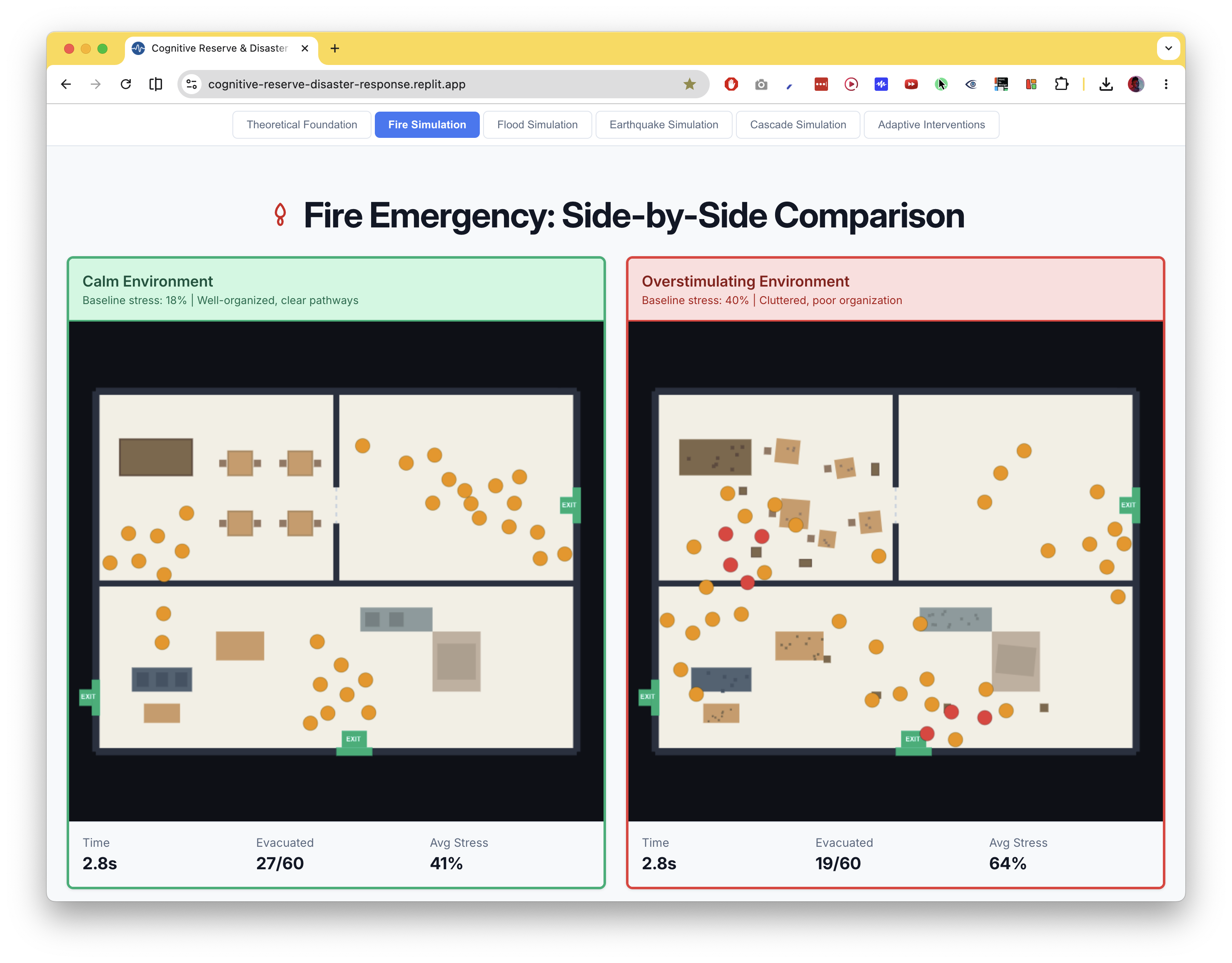
The simulation runs a side-by-side comparison of two identical floor plans. Same exits. Same square footage. Same number of occupants. The only variable is baseline stress environment — encoded as a starting cognitive reserve value assigned to each agent.
Low-stress agents begin with a cognitive reserve of 0.82. High-stress agents begin at 0.60. These values are not drawn from empirical studies of specific building types. They are proposed thresholds built to demonstrate the mechanics of the hypothesis. That distinction matters, and the simulation documents it.
Agent behavior is governed by several parameters tied to cognitive reserve:
Navigation efficiency describes how successfully an agent routes around obstacles. A low-stress agent navigating debris has roughly a 90% success rate per decision node. A high-stress agent drops to around 55%. Same debris field. Different capacity to read and respond to it.
Assessment time becomes relevant in earthquake scenarios, where protocol requires a pause before evacuation. High-reserve agents assess damage and begin moving in approximately five seconds. Low-reserve agents take eight or more. That gap compounds across a floor of 45 occupants moving toward two stairwells, one of which is blocked by debris.
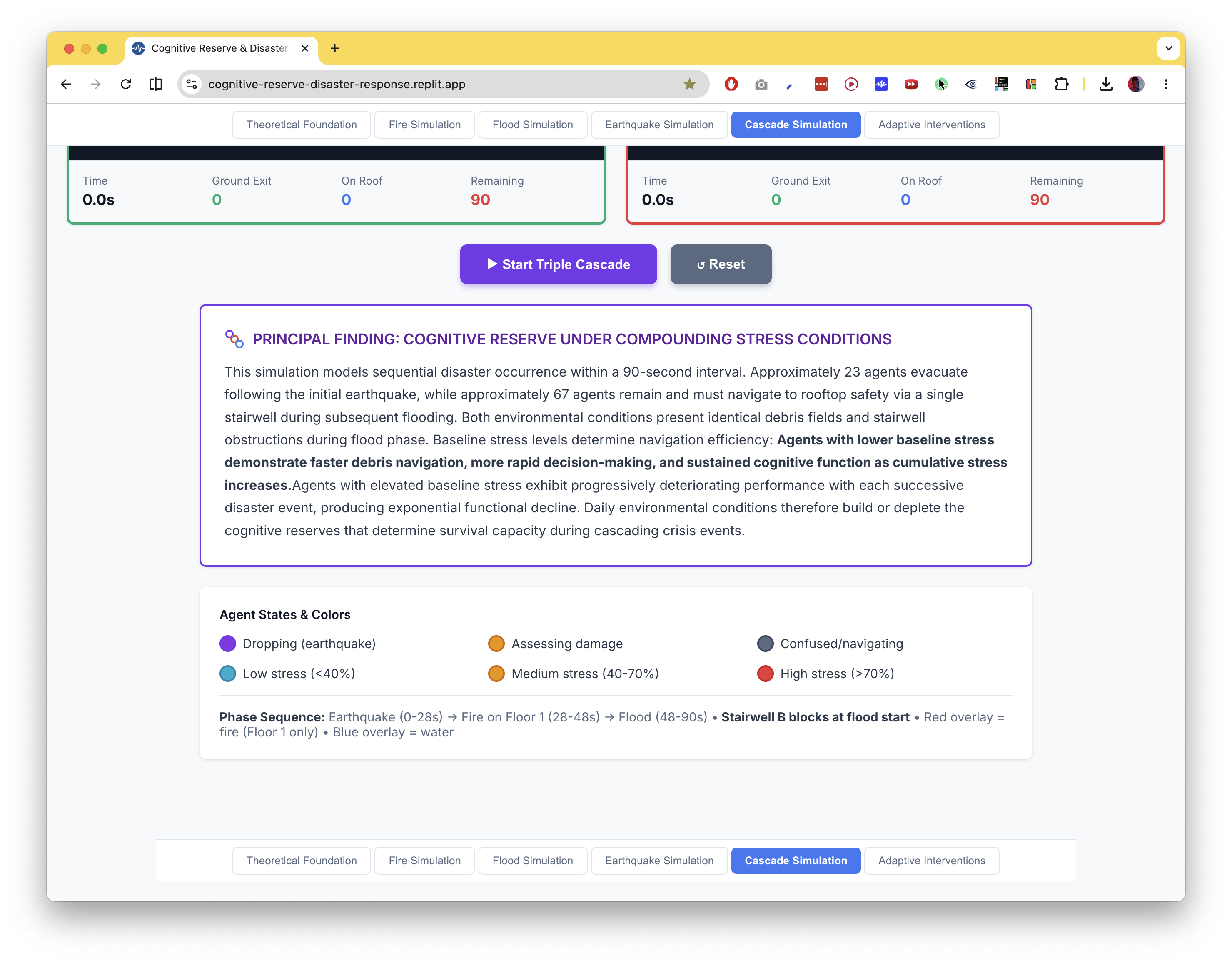
Stress accumulation tracks the degradation of cognitive reserve across compounding events. Each disaster phase — earthquake, then fire, then flood — adds to an accumulation variable that progressively reduces effective reserve. By the cascade simulation, even low-stress agents are operating at diminished capacity. The point is not that calm environments make people invincible. The point is that they enter the cascade with more to lose before failure begins.
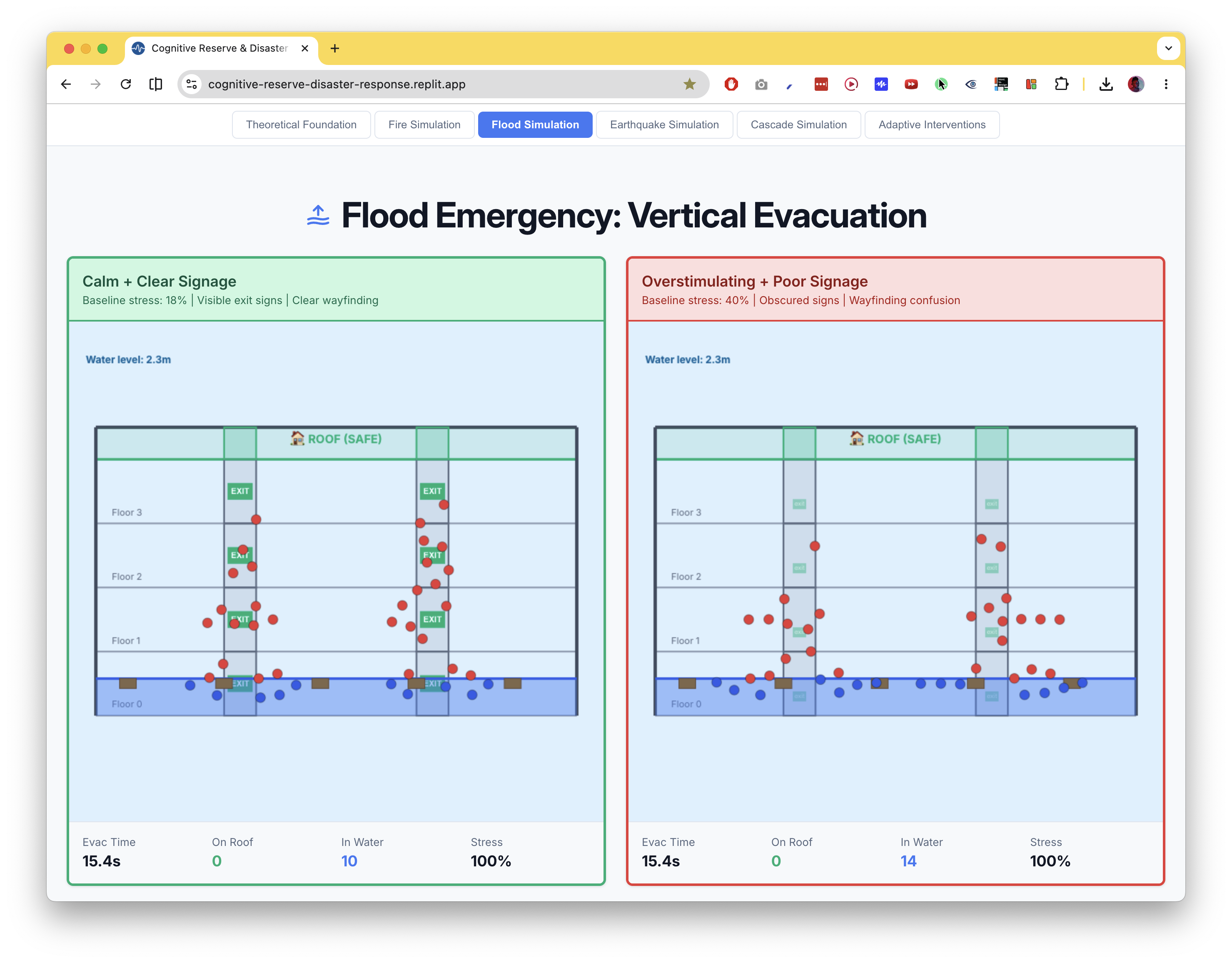
The simulations were built in React using agent-based logic written from scratch. Fire scenarios use a top-down 2D view appropriate to horizontal evacuation. Flood scenarios shift to elevation view because the movement pattern changes — occupants move up, not out. Earthquake scenarios use isometric projection to show structural damage across three spatial dimensions. The cascade simulation uses a three-floor cutaway with a blocked stairwell and rising water on the ground floor, modeling the exponential deterioration that results when disaster types compound.
Scenario Studies
Fire. The fire simulation was the first built, and it establishes the core comparison. Both environments use a standard office floor plan. A fire event initiates from a single origin point and spreads based on a propagation model. The result across multiple simulation runs: agents in the low-stress condition evacuate 15–25% faster than agents in the high-stress condition, given identical exits and identical fire behavior. The difference is entirely attributable to navigation efficiency and decision speed at path-choice nodes.
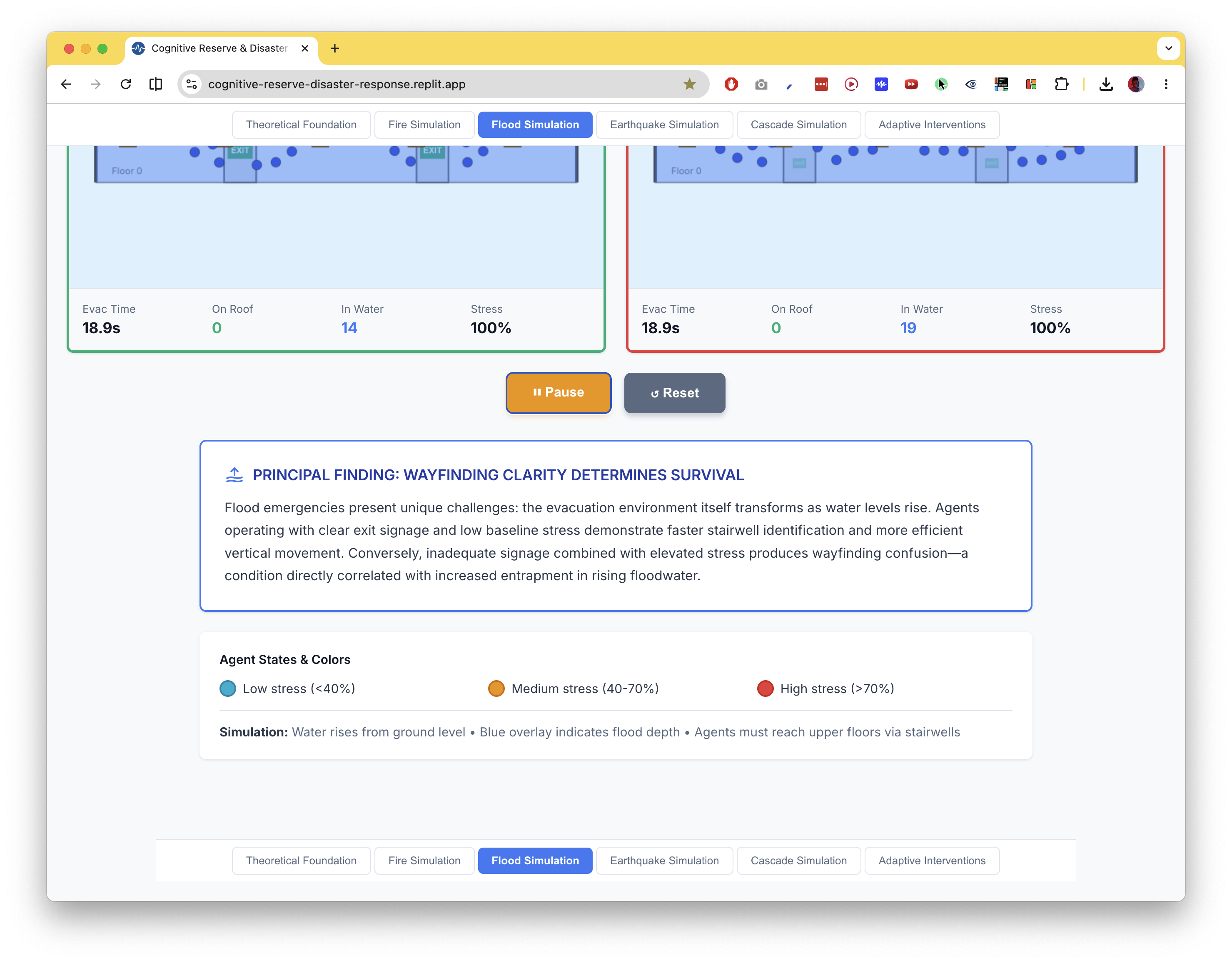
Flood. Floods require vertical movement. Horizontal evacuation is not the problem to solve. The elevation view was a deliberate choice — representing the problem correctly meant representing it spatially. The flood simulation introduces dynamic obstacles in the form of floating debris. High-stress agents hesitate more at stair-access decision points, producing bottlenecks. The bottleneck is the finding. It emerges from individual-level decision latency, not from any structural constraint.
Earthquake. The earthquake scenario introduced the assessment phase, which is where the cognitive reserve hypothesis is most legible. Building codes and emergency management protocol both specify that occupants should drop, cover, and hold during shaking — then assess before moving. The simulation models this. The gap between a 5-second and 8-second assessment phase, multiplied across 45 agents, determines whether a single functional stairwell can be used efficiently or becomes a compression point.
Cascade. The triple-cascade simulation — earthquake, then fire, then flood, sequentially — was built to model what disaster researchers call compounding events. The goal was to show that cognitive reserve degrades across time. Even agents who began with high reserve show measurable deterioration by the flood phase. The cascade scenario exposes the limit of the hypothesis: baseline environment sets the starting conditions, but it cannot hold against indefinite accumulation of disaster stress. What it can do is determine who still has margin when the third event begins.
Design Decisions Worth Defending
Why simulation rather than analytical modeling. Analytical models of evacuation are well-developed in the fire engineering literature. What they do not easily capture is behavioral variation tied to pre-event cognitive state. Agent-based simulation allows individual-level behavior to be parameterized — and for those parameters to be derived from a theoretical variable like cognitive reserve — in a way that differential equation models do not. The cost is precision. The gain is argument.
Why Kansei Engineering. Most approaches to disaster wayfinding focus on signage legibility, exit placement, and crowd dynamics. Kansei Engineering asks a different question: what does the environment feel like to be inside, and how does that feeling shape what people do next? Applying it to disaster contexts is not standard. That is why it felt worth doing.
Why side-by-side comparison as the primary visual structure. The comparison format is familiar from A/B testing. That familiarity is intentional. The simulation is making an argument to design audiences — people trained to evaluate variation between conditions. The format meets them where they already think. It also enforces the constraint that matters most: both environments must be physically identical. If they are not, the behavioral difference has a physical explanation, and the cognitive reserve hypothesis cannot be tested.
Why the three discrete scenario views. Top-down, elevation, and isometric are not interchangeable. Each represents a different spatial logic of disaster. Using the same view for all three scenarios would imply that fire, flood, and earthquake present the same wayfinding problem. They do not. The view is the argument about the problem type.
And the tl;dr
What This Opens
The simulation is a proof-of-concept for a hypothesis, not a validated model of human behavior. What it generates is a set of questions with more precision than the ones I started with.
The most significant: how would Structural Health Monitoring data change this model? SHM systems can provide real-time information about building condition during a seismic event — strain gauges, accelerometers, displacement sensors tracking structural integrity as shaking occurs. If an agent's assessment phase were informed by actual sensor data rather than a fixed time parameter, the model would begin to approximate the conditions of a smart building during an active event. That integration is technically within reach. The research question is whether it would produce meaningfully different evacuation outcomes — and whether those outcomes could be measured against existing empirical data from real events.
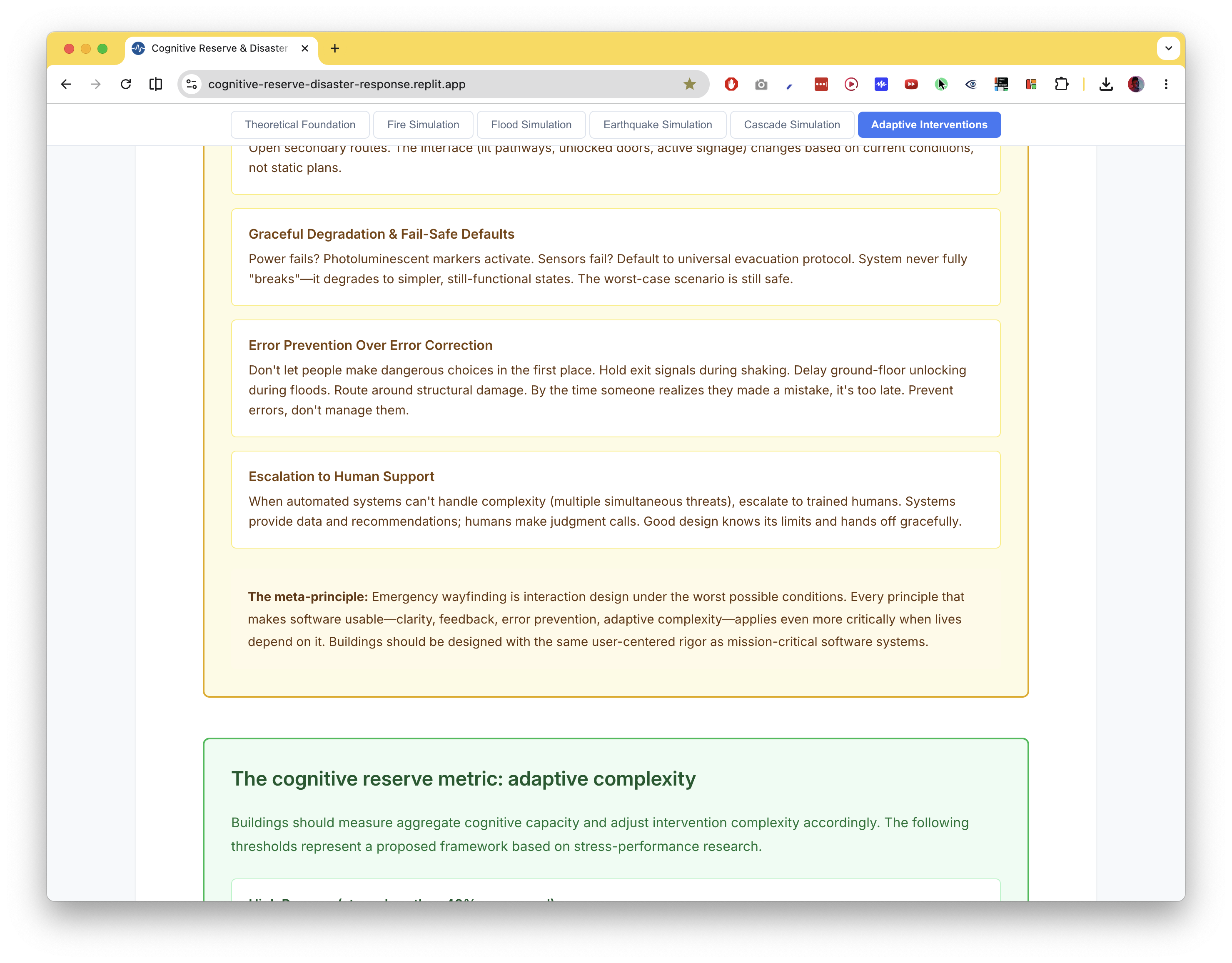
The second question is empirical validation. The cognitive reserve thresholds in this simulation (0.82 and 0.60) are proposed. They are reasonable, grounded in the general cognitive science literature on stress and performance degradation, but they are not derived from controlled studies of building occupants. Closing that gap would require environmental psychology research design, not simulation. The two methods are complementary, not substitutes.
The third question is equity. The simulation treats all agents as behaviorally equivalent within their stress condition. Real building populations are not. Older adults, people with mobility impairments, people with anxiety disorders, people with limited English proficiency, people who have experienced prior trauma — all of these groups likely have different baseline reserve levels and different degradation curves under disaster stress. A model that does not account for population heterogeneity cannot make claims about who actually survives.
These are the questions the simulation surfaces. Surfacing them is what it is for.
The Honest Reflection
The assumptions in the model are contestable. The cognitive reserve thresholds are proposed, not measured. The navigation efficiency parameters are reasonable, but they are not calibrated against real evacuation data. Any disaster engineering researcher reading this documentation should take the simulation as an illustrated argument, not an empirical finding.
What the project did successfully: it translated a theoretical claim from my thesis research into an interactive medium that makes the claim testable by observation. It forced me to make my assumptions explicit — to decide what values to assign and to defend why. It generated a cleaner set of research questions than I had before building it.
The project I most wish I could have built alongside it: a controlled environmental psychology study in two differently designed spaces, running identical wayfinding tasks under simulated time pressure, measuring cognitive load directly. The simulation models what that study might find. The study would tell us whether the model is right.
.png)